
Crew leave rarely makes headlines, but it touches almost everything an airline cares about: the contract with its crew, the flying programme it has sold, and the trust of the people who operate it. Today we are introducing offchox™, a specialist software application developed by Avison360 Limited for airline crew leave planning, bidding and allocation.
Why crew leave is still hard
Most airlines run sophisticated crew management systems for pairing, rostering and tracking. Leave is different. It sits where three sets of obligations meet, and each decision has to satisfy all of them at once:
- The agreement. Entitlements, seniority, bidding rounds and seasonal rules must be honoured precisely, for every crew member.
- The operation. Leave can only be granted where the flying programme can still be crewed.
- The crew. Crew expect fair, consistent decisions and a clear explanation of every outcome.
In practice, applying those rules often still depends on spreadsheets, manual workarounds and the knowledge of a few experienced planners. When the rules are encoded in a larger crew system, changing them can mean slow and costly development work.
Agreements change, and every change has to be applied exactly
Crew leave agreements are detailed, and they are renegotiated. A change to entitlements, points or a seasonal restriction has to be reflected correctly for every crew member it affects, from the next bidding round onwards. The harder it is to change the rules in the system, the more an airline relies on manual checks, and the more room there is for inconsistent outcomes that undermine confidence on both sides.
From policy document to approved rules
offchox starts from the agreement itself. The airline uploads its crew leave policy document, and the offchox AI-assisted rules engine interprets it into configurable rules covering entitlements, bidding priorities and allocation conditions.
Those rules are a proposal, not a decision. The airline's planning team reviews and approves the interpreted rules before they are used. Bidding and allocation then follow the approved rules, so the airline stays in control of how its agreement is applied and can show how each outcome was reached.

Bidding, allocation and crew self-service
Planners set up leave seasons and bidding rounds, run the allocation using the approved rules, and review the results before they are confirmed and published to crew. Entitlements, seniority, points and seasonal rules are applied consistently, using the allocation methods agreed by the airline.
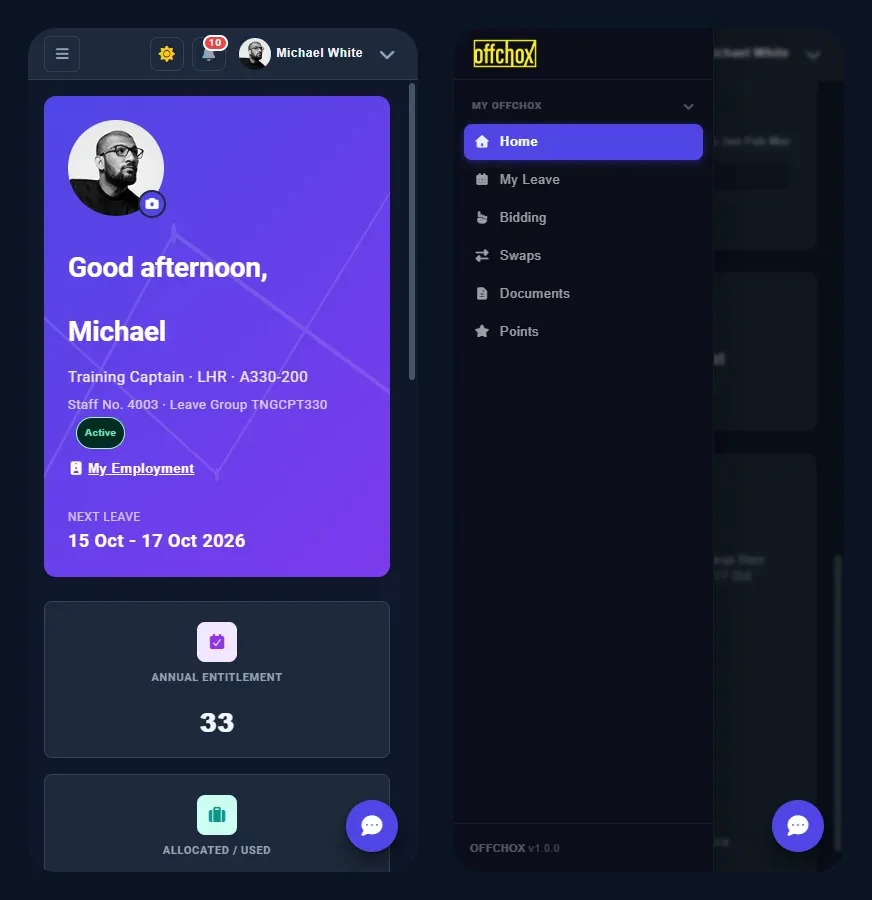
Crew see their entitlement, bids, leave, swaps and documents in one place, on any device. As bidding progresses they can see how competitive their preferred dates are, and when results are published they can see the outcome and understand it. Giving crew direct access to that information also reduces routine enquiries to the planning team.
Protecting operational capacity
Every airline has to balance two things: crew need enough opportunity to take the leave they are entitled to, and the operation needs enough crew to fly the programme. offchox manages these separately.
- Leave opportunity: a wider choice of dates on which crew can request leave.
- Leave allocation: a weekly Leave Cap, the maximum number of crew from a leave group who can be approved on leave in the same week. Each request is checked against it at the point of approval.
Planners can see, week by week, how approved and requested leave compares with the cap, and where demand is building. offchox suggests a recommended level based on historical weekly leave demand, which planners can use to set and adjust their Leave Caps.
Policy What-if: understanding a change before agreeing it
When an agreement is being renegotiated, the most useful thing both sides can have is the same set of figures. offchox helps in two ways.
First, when a revised policy document is uploaded, offchox can compare its interpreted rules with those of the previous version, showing which entitlement and allocation rules have been added or changed, with the prior and new values side by side.
Second, the What-if scenario planner models a change in entitlement, adding or removing a number of days per crew member, for a selected population of crew, such as a leave group, base, rank or fleet. It compares the current position with the scenario: the crew affected, the change in entitlement days, the resulting remaining entitlement, the leave capacity needed, and any additional capacity required beyond the leave dates already offered. It also identifies the leave groups most affected. For a single leave group and season, it shows the Leave Cap headroom available alongside the entitlement change, so planners can judge for themselves whether the operation can absorb it.
Airline management and crew representatives may weigh those results differently, and that is expected. What matters is that the discussion starts from a shared understanding. Scenarios are simulations for planning and discussion only. Nothing is saved, and live leave data is never changed.
Designed to complement existing crew systems
offchox is a cloud-based application delivered as a managed service. It can be used as a standalone solution for crew leave, or connected to an airline's existing systems through interfaces agreed with each airline during implementation. There is no requirement to replace the systems an airline already relies on for pairing, rostering or HR.
A product, separate from our consulting
offchox is a software product developed by Avison360 Limited. Our consulting services remain independent: when we advise an airline on its crew or operations systems, our recommendations are led by the airline's requirements, and we disclose our ownership of offchox before it is considered. You can read more in our independence and disclosure statement.
